According to Xero, AI can automate approximately 80% of routine bookkeeping tasks. That number is impressive. But it is not the number most small business owners care about when they are considering the switch.
The question they are actually asking is simpler and more personal than that: what happens if something goes wrong?
This article answers that honestly — with real data, a real sceptic's opinion, and a clear picture of where AI bookkeeping stands in 2026.
What AI Bookkeeping Software Actually Does Well
Before talking about accuracy, it helps to be clear about what AI bookkeeping is actually being asked to do. The tasks it handles are specific and repetitive by nature — which is exactly why automation works well for them.
- Transaction categorisation — sorting every bank transaction into the right expense category automatically
- Bank reconciliation — matching your transactions against your bank statements (QuickBooks reports a 90% automation rate here)
- Receipt scanning — reading a photo of a receipt and extracting the relevant data
- Data extraction — pulling figures from invoices and bills without manual entry
- Invoice matching — connecting incoming payments to the correct outstanding invoice
- Basic financial report generation — producing profit and loss, balance sheet, and cash flow reports automatically
These are not glamorous tasks. But they represent the bulk of what a bookkeeper spends their time on every month. And for these tasks, modern AI is genuinely reliable.
Where Human Expertise Is Still Irreplaceable
Accuracy has limits — and being honest about those limits is more useful than pretending they do not exist.
- Complex journal entries — anything that requires understanding the business context behind a transaction
- Tax strategy — AI can record tax-relevant transactions but cannot advise you on how to structure them
- Audit preparation — the judgment calls required for audit defence still need a qualified professional
- Financial advisory — understanding what your numbers mean for your business decisions requires human insight
The pattern is consistent: AI handles the data work. Humans handle the thinking work. This is not a weakness of AI bookkeeping — it is simply an honest description of what the technology is and is not designed to do.
The Honest Sceptic's View
Not everyone is convinced, and it is worth hearing the other side.
As one accountant on Reddit put it bluntly:
"AI bookkeeping software tends to be about as accurate as a first-year graduate — which is to say, not very."
That is a fair observation — for month one. The first 30 days of any AI bookkeeping platform involve a learning period where the software is still building its understanding of your specific transaction patterns. Errors are more frequent during this phase.
By month three, the picture looks different. The same software that was making frequent categorisation errors in week one is now handling the same transactions automatically and correctly — without sick days, without salary increases, and without the distraction of managing twenty other clients at the same time.
The first-year graduate analogy is accurate for the onboarding period. It does not describe what the software becomes after that period ends.
Can AI Bookkeeping Be Trusted for Real Business Finances?
The practical answer for most small businesses: yes, with a monthly review process in place.
No bookkeeping system — human or AI — should run without oversight. A professional bookkeeper makes errors too. The difference is that AI errors appear in a review queue immediately, where you can see and correct them. Human errors are often invisible until your accountant finds them at year end.
The workflow that works in practice:
- AI handles all routine transactions automatically throughout the month
- You review flagged and uncertain items once a week — takes 10 to 15 minutes
- At month end, you do a final review of the summary — takes 30 to 45 minutes
- Your accountant receives clean, organised data and focuses on advice rather than data entry
Test AI Accuracy on Your Own Transactions
If you want to see how AI bookkeeping performs in practice, try connecting your own transactions and review how the software categorizes them during the first few weeks.
Most AI bookkeeping platforms require no technical skills to set up and can be running within an hour of connecting your bank account. The learning curve is genuinely low.
The Verdict: AI Plus Human Is the Smartest Setup
The most accurate answer to whether AI bookkeeping can be trusted is not yes or no — it is for what, specifically.
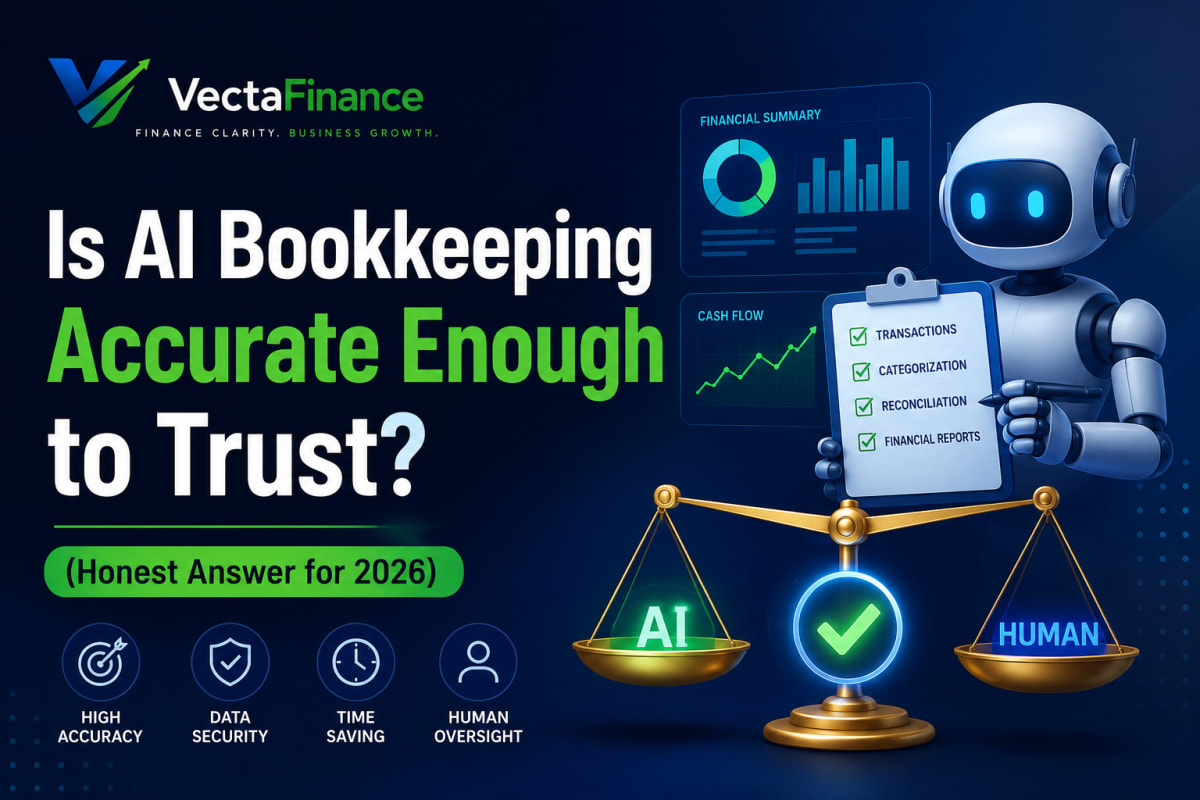
For routine, repetitive, data-heavy tasks — categorisation, reconciliation, receipt capture, invoice matching — AI bookkeeping in 2026 is accurate enough to trust as your primary system, with monthly human review.
For complex judgment calls, tax strategy, audit defence, and financial advisory — you still need a qualified professional.
The businesses getting the best results are not choosing between AI and human. They are using AI to handle the routine 80% automatically, and keeping a part-time bookkeeper or accountant for the 20% that requires genuine expertise. That combination reduces errors, saves significant time, and costs less than either option running at full capacity alone.
AI is not replacing bookkeepers. It is changing what bookkeepers spend their time on — and for most small businesses, that change is a meaningful improvement.
Try Xero Free for 30 Days
The easiest way to test AI bookkeeping accuracy on your own transactions. No credit card required. Connect your bank account and see the results within the first week.
If you are still deciding whether AI bookkeeping is right for your situation, start with the basics: our plain English guide explains exactly how the technology works and what to expect in the first 60 days.
Already convinced but unsure about costs? Our full cost comparison breaks down AI bookkeeping versus hiring a human across three different business sizes.
Frequently Asked Questions
Ready to try VectaFinance yourself?
Upload any bank CSV, Stripe, QuickBooks, or Xero export and receive a professional financial report with clear insights — usually within 24 hours.
Create Free Account & Test NowNo credit card required • 2 free reports every month • Cancel anytime