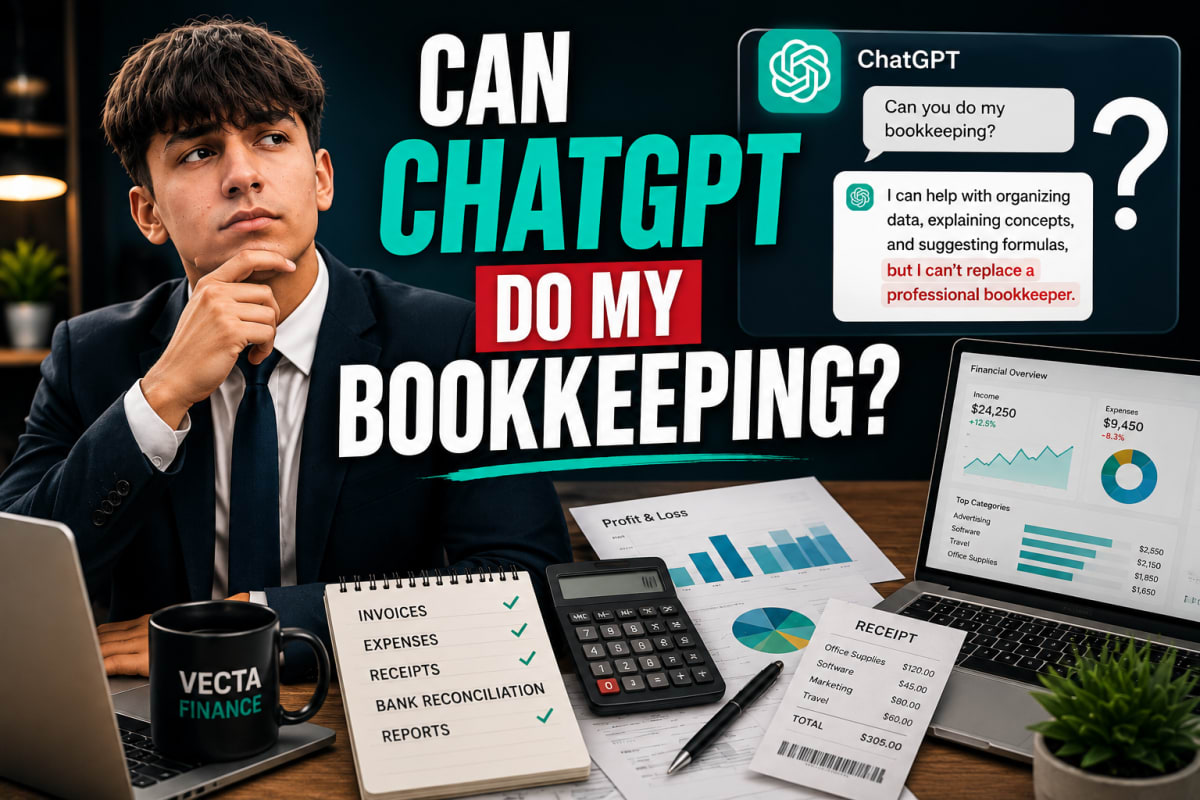
I spent 30 minutes testing ChatGPT for bookkeeping so you do not have to.
According to Google searches, most people asking this question have already pasted a transaction into ChatGPT and got a reasonable-looking answer. So the question naturally follows — if it can handle that, why not just use it for everything?
I tested it properly with real questions to find out. Here is exactly what happened — in ChatGPT's own words.
First Question: Can ChatGPT Actually Handle Bookkeeping?
I started with the most direct question possible.

Me: Can you handle my bookkeeping? Keep the answer concise.
ChatGPT: "Yes — I can help you with bookkeeping tasks like tracking income and expenses, organizing transactions, creating ledgers, profit and loss summaries, invoices, and explaining accounting concepts step by step."
That sounds promising. But notice something important in that answer — every single thing it listed involves you providing the data first. It cannot go and get anything. It waits for you to bring it information, then it helps you organise that information.
That distinction matters enormously, and it becomes clearer as the conversation continues.
ChatGPT vs Xero and QuickBooks: The Real Difference
My second question got to the heart of the matter.
Me: What bookkeeping capabilities do you offer compared to tools like Xero and QuickBooks?
ChatGPT gave an unusually honest and clear answer. I am quoting it in full because it is the most accurate summary of the difference I have seen anywhere.
What ChatGPT offers (guidance and custom work):
- Categorising transactions you provide
- Explaining bookkeeping concepts in plain English
- Creating spreadsheets, ledgers, invoices, and reports
- Reviewing entries you bring to it for mistakes
- Summarising financial data
- Helping automate workflows with code or scripts
- Teaching you how to use accounting systems
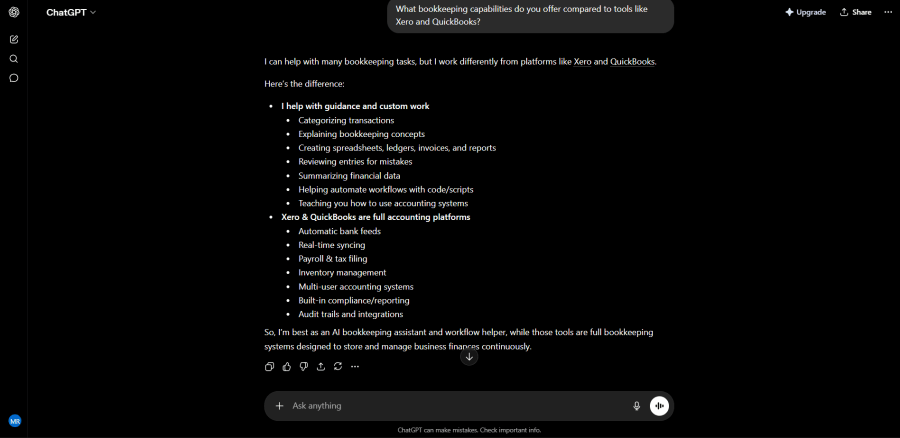
What Xero and QuickBooks offer (full accounting platforms):
- Automatic bank feeds — they pull your transactions in
- Real-time syncing with your accounts
- Payroll and tax filing
- Inventory management
- Multi-user accounting systems
- Built-in compliance and reporting
- Audit trails and integrations with other business software
ChatGPT's own conclusion from that answer: "I am best as an AI bookkeeping assistant and workflow helper, while those tools are full bookkeeping systems designed to store and manage business finances continuously."
That is the clearest explanation of the difference I could have asked for — and it came from ChatGPT itself.
Can ChatGPT Replace a Human Bookkeeper?
This is the question most people actually want answered.
Me: Can you replace a human bookkeeper?
ChatGPT: "Partially — for simple businesses, I can reduce a lot of bookkeeping work, but I cannot fully replace an experienced human bookkeeper in every situation."
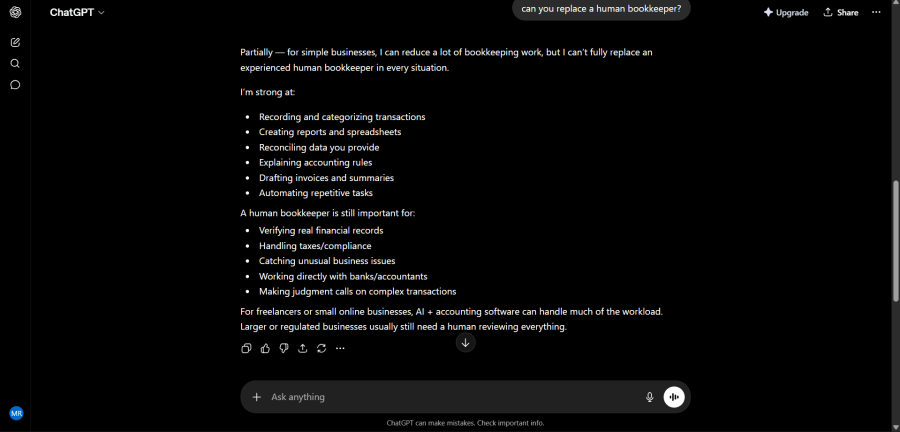
It then listed what it is strong at and where a human is still important. The honest summary from the conversation:
ChatGPT handles well: Recording and categorising transactions you provide, creating reports and spreadsheets, reconciling data you give it, explaining accounting rules, drafting invoices and summaries, automating repetitive tasks with scripts.
A human bookkeeper is still needed for: Verifying real financial records directly, handling taxes and compliance, catching unusual business issues that require judgment, working directly with banks and accountants, making calls on complex transactions.
ChatGPT's own recommendation: "For freelancers or small online businesses, AI plus Accounting Software for Small Businesses?">Accounting Software for Small Businesses in the USA (2026 Honest Reviews)">accounting software can handle much of the workload. Larger or regulated businesses usually still need a human reviewing everything."
That is a fair and accurate assessment. The combination of ChatGPT as an assistant plus dedicated bookkeeping software reduces hours significantly — but the combination is the point, not ChatGPT alone.
The Bank Account Test: The Most Important Question
This is where I pushed to the core limitation.
Me: My bank statement shows these transactions this month — can you categorise them and update my books automatically?
ChatGPT: "I can categorise the transactions and prepare bookkeeping entries or an updated ledger from the statement you provide. However, I cannot automatically update live books or sync directly with your bank or accounting software like Xero or QuickBooks. If you upload the statement, I can still organise it into categories and generate the bookkeeping records for you."
Two things to notice in that answer:
First — "I cannot automatically update live books." This means every time you want to do bookkeeping with ChatGPT, you are doing it manually. You download your bank statement, you upload it to ChatGPT, you copy the output somewhere. Repeat every month. That is a workflow, not an automation.
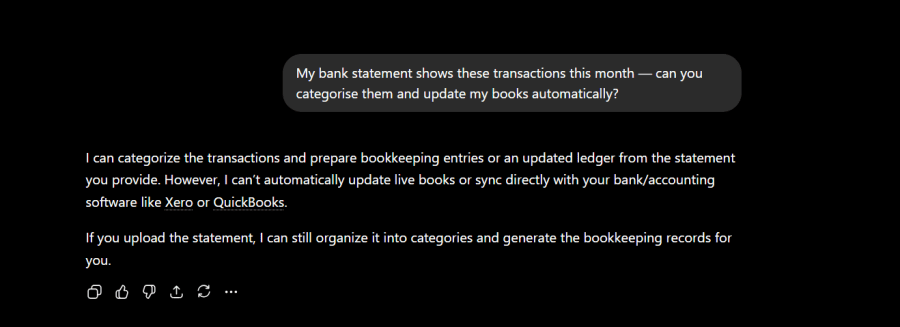
Second — "I can still organise it into categories and generate the bookkeeping records for you." This is genuinely useful — but only if you have the time and discipline to do it consistently every month. Most small business owners do not.
Where ChatGPT Actually Helps in Accounting
After all those limitations, it is worth being clear about where ChatGPT genuinely earns its place in a finance workflow.
In my research and testing, these are the situations where it adds real value:
- Understanding accounting jargon — ask it to explain what a deferred tax liability is or what EBITDA actually means, and it explains it clearly in plain English
- Drafting financial emails — chasing overdue invoices, writing payment terms, responding to supplier queries — ChatGPT drafts these faster than any human
- Preparing questions for your accountant — before a meeting, describe your situation and ask ChatGPT what questions you should be asking. This alone saves most small business owners significant money on accountant time
- Analysing data you paste in — if you copy your monthly expenses and paste them in, ChatGPT will identify patterns, flag anomalies, and summarise trends clearly
- Creating invoice templates — describe your business and it builds a professional invoice template you can reuse
None of these replace a bookkeeper. All of them make a small business owner smarter and faster at the parts of finance that do not require dedicated software.
The Honest Verdict
ChatGPT cannot do your bookkeeping. Not in the way most people imagining when they ask the question.
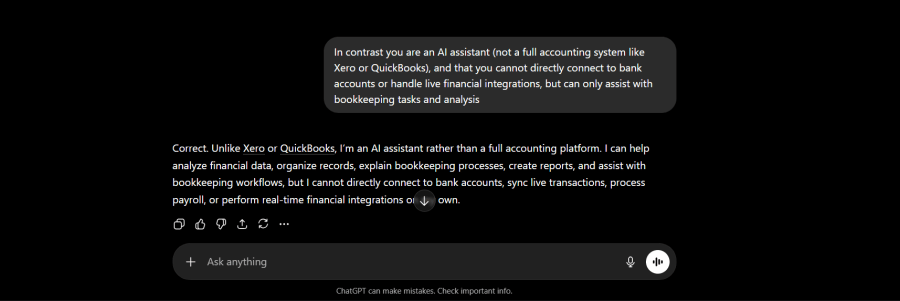
It cannot connect to your bank. It cannot automatically categorise your transactions. It cannot update your books, file your VAT, run your payroll, or maintain an audit trail. These are not opinions — ChatGPT confirmed all of them directly in our conversation.
What it can do is act as a genuinely useful manual assistant. If you bring it data, it will help you organise, analyse, and understand that data faster than doing it alone. For freelancers with simple finances and the discipline to manage a manual workflow, that is worth something.
But for most small business owners, the actual answer to "can ChatGPT do my bookkeeping" is: not without significant manual effort from you every single month.
The smarter approach is what ChatGPT itself recommended — AI plus dedicated bookkeeping software. Let the software handle the automation (bank feeds, categorisation, reconciliation) and use ChatGPT for the analysis, explanation, and drafting work it genuinely does well.
Try Xero Free for 30 Days
The automated bookkeeping that ChatGPT cannot do. Connects to your bank, categorises transactions automatically, and keeps your books current — without you doing it manually every month.
New to AI bookkeeping and not sure how it actually works? Our plain English guide explains exactly what AI bookkeeping does — and why it is fundamentally different from a general AI assistant like ChatGPT.
Already convinced you need proper software but unsure about the cost? Read our full cost comparison between AI bookkeeping software and hiring a human bookkeeper.
Frequently Asked Questions
Ready to try VectaFinance yourself?
Upload any bank CSV, Stripe, QuickBooks, or Xero export and receive a professional financial report with clear insights — usually within 24 hours.
Create Free Account & Test NowNo credit card required • 2 free reports every month • Cancel anytime