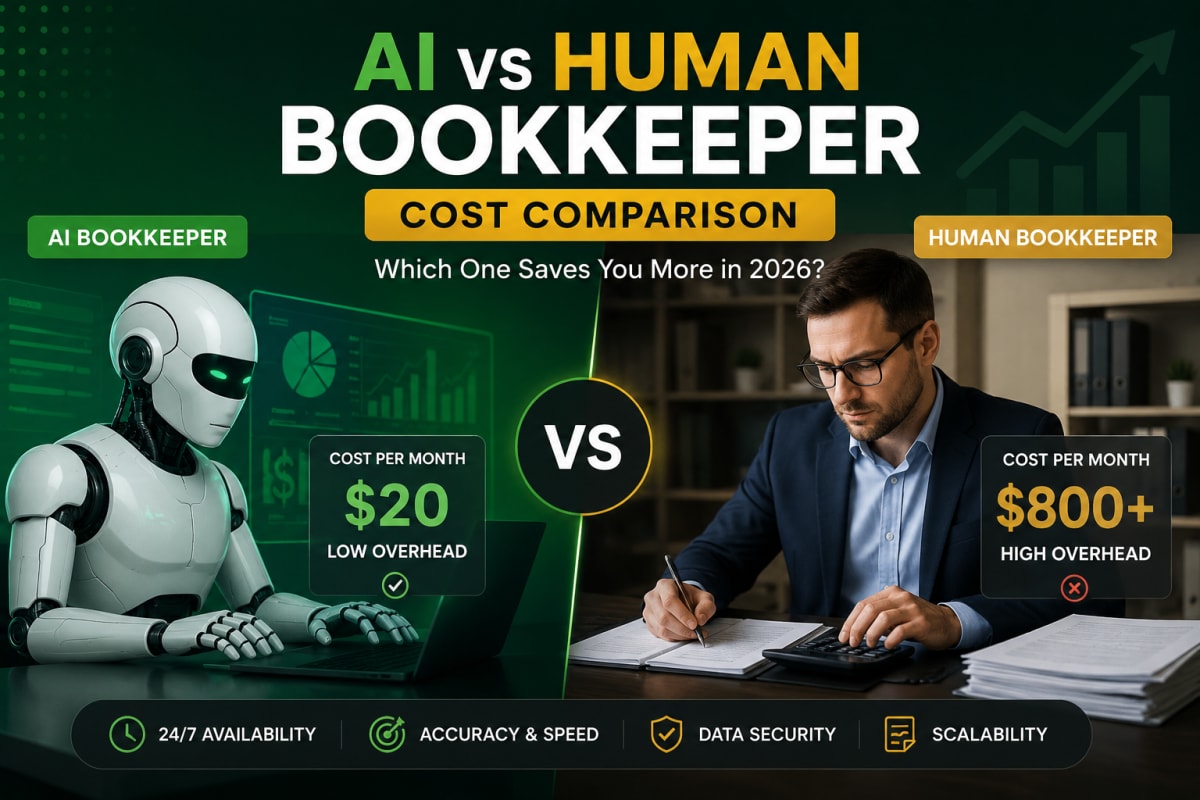
Here is something most bookkeeping articles will not tell you: the answer to "which is cheaper" is not the same for every business. A freelancer with 40 transactions a month has a completely different calculation than an accounting firm managing 20 clients.
So instead of giving you a vague "it depends," this article breaks down the real numbers for three different business sizes — and tells you exactly which option makes financial sense for each one.
The Real Cost of a Human Bookkeeper in 2026
Let us start with the option most people already understand.
A part-time freelance bookkeeper typically charges between $25 and $50 per hour depending on experience and location. For a small business with moderate transaction volume, expect them to spend 4–8 hours per month on your books.
That puts your monthly cost somewhere between $100 and $400 — just for the basic data entry and reconciliation work. Add payroll processing, VAT returns, or anything beyond standard bookkeeping and that number climbs fast.
If you hire a bookkeeper as a part-time employee rather than a contractor, the cost is higher again. A part-time bookkeeper at 20 hours per week in the US earns roughly $2,000–$2,800 per month before benefits, taxes, and employer contributions — which typically add another 20–30% on top.
Full-time bookkeeper? You are looking at $45,000–$65,000 per year in salary alone, plus benefits. That is $3,750–$5,400 per month for one person whose entire job is managing your financial records.
The Real Cost of AI Bookkeeping Software in 2026
AI bookkeeping software works on a flat monthly subscription. You pay the same amount whether you have 50 transactions or 500. That predictability is one of its biggest practical advantages.
Here is what the major platforms actually cost in 2026:
| Platform | Starting Price / Month | Best For |
|---|---|---|
| Xero | $15 (Starter) / $42 (Standard) | Small businesses, freelancers |
| QuickBooks | $35 (Simple Start) / $65 (Plus) | US-based small businesses |
| Wave | $0 (free tier available) | Freelancers just starting out |
| FreshBooks | $19 / $33 (Plus) | Service-based freelancers |
| Botkeeper | $69+ per client / month | Accounting firms managing multiple clients |
The time cost is where the real saving happens though. Most small business owners using AI bookkeeping spend 30–60 minutes per month reviewing what the software flagged. Compare that to the 4–8 hours most spend doing it manually — or the time spent briefing and managing a human bookkeeper.
Side-by-Side Cost Comparison: Three Business Types
Generic comparisons are useless. Here is the breakdown for three specific situations.
Scenario 1 — Freelancer with 50 transactions per month
| Human Bookkeeper | AI Software (Xero Starter) | |
|---|---|---|
| Monthly cost | $100–$150 (3hrs at $35/hr) | $15–$42 |
| Your time spent | 2–3 hrs briefing + reviewing | 30–45 minutes reviewing |
| Annual cost | $1,200–$1,800 | $180–$504 |
| Verdict | Overkill for this volume | Clear winner |
Scenario 2 — Small business with 200–300 transactions per month
| Human Bookkeeper | AI Software (QuickBooks Plus) | |
|---|---|---|
| Monthly cost | $250–$400 (6–8hrs at $40/hr) | $65 |
| Your time spent | 3–4 hrs managing + reviewing | 45–60 minutes reviewing |
| Annual cost | $3,000–$4,800 | $780 |
| Verdict | Hard to justify at this volume | Clear winner |
Scenario 3 — Growing business with complex needs
| Human Bookkeeper | AI Software Alone | |
|---|---|---|
| Monthly cost | $1,500–$2,500 (part-time employee) | $65–$150 |
| Handles exceptions? | Yes, fully | Not reliably |
| Multi-entity support | Yes | Limited |
| Verdict | Human OR hybrid model | Not enough on its own |
The pattern is clear: AI software wins on cost at almost every transaction volume until you hit genuine complexity — multiple entities, irregular transactions, or situations that require human judgment on a regular basis.
The Hidden Costs Nobody Mentions
The subscription price and hourly rate are not the full picture on either side.
Hidden costs of a human bookkeeper:
- Time spent briefing them every month on your business changes
- Delays — a bookkeeper working across multiple clients does not always prioritise your deadline
- Finding a replacement if they leave or are unavailable at a critical moment
- The cost of errors — human bookkeepers make mistakes too, and fixing them takes time
Hidden costs of AI bookkeeping:
- Setup time — expect 2–4 hours in the first month to connect accounts and train the software on your categories
- Monthly review time — you still need to check what the AI flagged, which takes 30–60 minutes per month
- Learning curve — most platforms take 30–60 days to reach full accuracy, during which you will correct more errors than usual
- You still need an accountant for tax — AI bookkeeping does not replace professional tax advice
Where a Human Bookkeeper Still Wins
This article is not anti-human bookkeeper. There are situations where a human is genuinely the better choice, and you should know what they are.
You need a human if:
- Your transactions are highly irregular or complex — construction businesses, project-based billing, multi-currency international operations
- You need someone to make judgment calls, not just categorise — a human can notice that a transaction looks unusual and call you about it
- You are behind on your books and need catch-up work done — AI software works best when it is set up from the start, not when you are three months behind
- You want a relationship with someone who understands your business — some business owners genuinely value having a person they can call with questions
The honest answer for most of these situations is a hybrid: use AI software to handle the routine 90% of transactions automatically, and keep a part-time human bookkeeper for 1–2 hours per month to handle the exceptions and provide the human oversight layer.
That hybrid model typically costs $50–$100 per month total — far less than either option alone at full capacity.
The Verdict: Which Should You Choose?
| Your Situation | Best Choice |
|---|---|
| Freelancer, under 100 transactions/month | AI software (Wave or Xero Starter) |
| Small business, 100–500 transactions/month | AI software (Xero or QuickBooks) |
| Growing business, complex or irregular transactions | Hybrid — AI software + part-time human |
| Multi-entity, high volume, or regulated industry | Full-time human or specialist firm |
| Accounting firm managing multiple clients | AI platform (Botkeeper) |
If you are reading this article, there is a very high chance you fall into the first or second row. The vast majority of small businesses and freelancers are overpaying for bookkeeping right now — either in money paid to a human for work AI can do, or in their own time spent doing it manually.
Try Xero Free for 30 Days
The easiest way to test AI bookkeeping without committing. No credit card required. Most users see their first automated reconciliation within 24 hours of connecting their bank account.
The Bottom Line
For most businesses, AI bookkeeping software is significantly cheaper than a human bookkeeper — not by a small margin, but by 70–90% in many cases. The software has also become accurate enough that the quality difference, which was a real concern three or four years ago, is no longer a serious argument against it for routine transaction work.
The cases where a human bookkeeper still makes sense are real, but they are specific. If your business has genuinely complex, irregular, or high-judgment bookkeeping needs, a human is the right call. If you are paying a bookkeeper $200–$400 per month to categorise straightforward transactions and reconcile a bank account, you are almost certainly overpaying.
Not sure what AI bookkeeping actually does before you commit to it? Start with our plain English explainer — it covers exactly how the technology works and what to expect in the first 60 days.
Frequently Asked Questions
Ready to try VectaFinance yourself?
Upload any bank CSV, Stripe, QuickBooks, or Xero export and receive a professional financial report with clear insights — usually within 24 hours.
Create Free Account & Test NowNo credit card required • 2 free reports every month • Cancel anytime