
2026 Tax Season: Basic Context
The IRS opened the 2026 filing season on January 26, 2026, and began accepting and processing individual federal income-tax returns for tax year 2025. The federal deadline for individual returns was April 15, 2026. The IRS expected approximately 164 million individual returns to be filed. For tax professionals, the IRS also published technical information concerning the 2026 Modernized e-File (MeF) system, including updated schemas and business rules for the Form 1040 series and extensions. The IRS released the first 2026 version on May 28, 2026, with another version released in July . The 2026 tax season isn't just about AI. Accountants are working within an increasingly digital tax-filing system, so AI is being introduced into an environment that already relies heavily on technologyWhy should AI be used?
When accountants/tax professionalists were asked about their top strategic priorities for the coming year, survey respondents mentioned efficiency and promoting firm growth as the top factors on the strategic agenda for 2026, even more emphatically than they did in 2025. AI is exceptionally efficient at automating routine, data-heavy tasks, reducing human error, accelerating financial reporting, and analyzing large volumes of transactions for anomaly and fraud detection.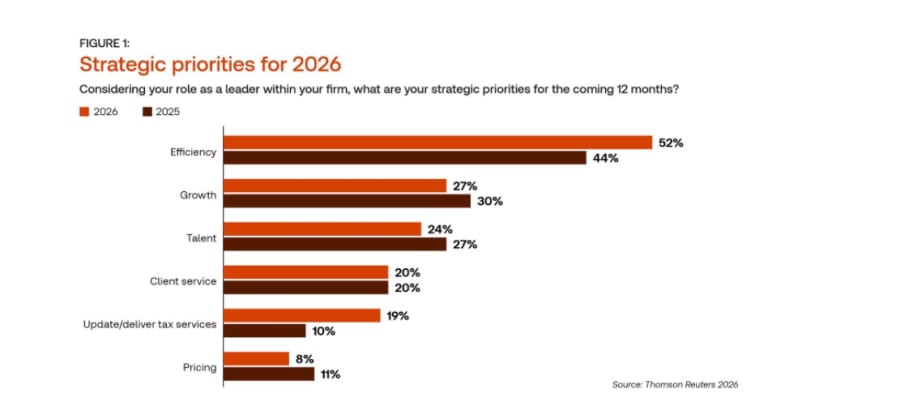
How accountants are using AI
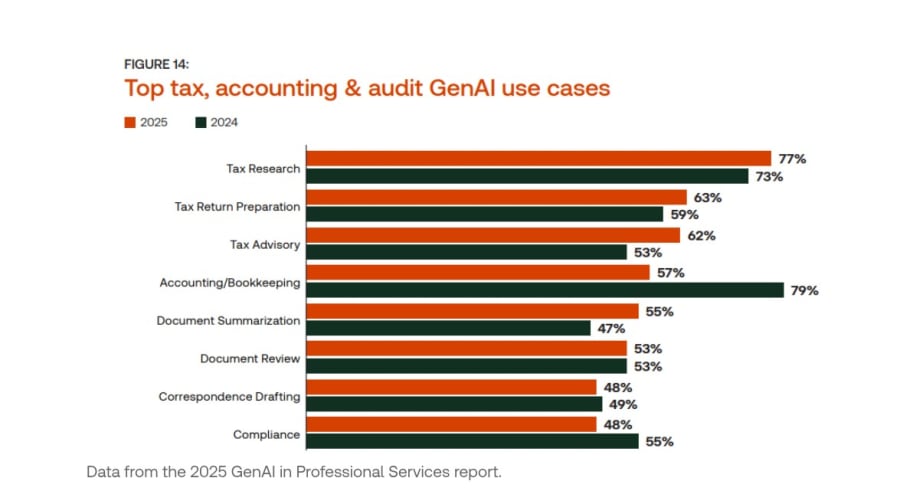
The use of AI in different industries has been on a drastic rise recently especially accounting. AI proves to be an efficient tool in accounting. Accountants use AI for many different reasons. According to a survey Only 11% of firms report using no automation at all, down from 18% in 2025 , 44% of respondents now automate up to a quarter of their tax workflow 27% say they’re automating up through AI.- Audit document review Accountants have been using AI powered tools to perform initial reviews of audit documentation and suggest enhancements for clarity and consistency. AI is transforming audit document reviews through automating routine data entry, accelerating month-end closes, and conducting rapid tax and audit research. By deploying specialized tools and generative AI models, firms reduce manual errors and reallocate time toward high-value advisory and strategic client consulting.
- Client solutions Accountants use AI to analyze client reviews and give feedback. AI proves to be extremely efficient in different kinds of analysis, providing real time insights and giving feedback. Tools like Digits and specialized platforms read messy documents, match transactions, and draft reports, letting accountants shift from data entry to high-value advisory services.
- IT In-house teams at PwC have developed customized software applications for employees that can synthesize data, complete and review code, conduct granular troubleshooting, and more. They have recorded 20% to 50% productivity gains in their development processes because of GenAI. Additionally, PwC estimates that a new end-to-end AI-driven audit solution will be complete in 2026
How is AI affecting accounting?
Nearly all accounting professionals (98%) have used AI software to support their clients, according to the 2024 Intuit QuickBooks Accountant Technology Survey. More than a quarter (27%) of accountants and bookkeepers consider it critical to the industry’s survival. Accountants already work long hours. And during tax season, 50- to 55-hour weeks are common. AI in accounting helps firms improve accuracy and catch problems earlier. In QuickBooks’ 2025 survey, 98% of respondents reported improvement in accuracy from automation. This shift is likely to continue, but probably not in a fully hands-off way. Cpa.com says one of the strategic themes taking shape is human-in-the-loop verification. That signals a future where AI handles more of the first-pass review work while accountants focus on judgment and exception handling. The more likely future is not error-free accounting by machine, but a more reliable review process where AI supports accuracy at scale and professionals step in when context and judgment are needed.Which types of firms use it
Accounting firms of all sizes are adopting AI, ranging from large global networks using custom platforms to small local practices utilizing cloud software [0.5]. Adoption varies by firm type based on resources, client base, and service focus. Firms like Deloitte, Ernst & Young (EY), PwC, and KPMG are investing billions in AI platforms. AI is no longer just a dream/fantasy, it is already becoming the reality and as Richard Baldwin says ‘ AI will not take you jobs. People using AI will.What AI Is Actually Doing During Tax Season
The general case for AI in accounting is well established. What is more useful for a practitioner is knowing which specific parts of a filing season it currently helps with, and which it does not. The pattern in 2026 is that AI is strongest at the front of the process and weakest at the point of judgment.
| Stage of the return | Where AI is reliable today | What still needs a person |
|---|---|---|
| Document intake | Sorting, classifying and extracting figures from client documents | Chasing missing documents; judging whether a document is complete |
| Reconciliation | Matching transactions and flagging unexplained differences | Deciding how an unusual item should be treated |
| Preparation | First-pass drafting, calculations and research | Applying the law to a specific client's facts |
| Review | Consistency checks across a whole return; spotting anomalies | The sign-off, and the professional liability that comes with it |
| Filing | Validation against MeF schemas and business rules before submission | The act of filing and responsibility for its accuracy |
The 2026 Modernized e-File system illustrates the point well. The IRS published updated schemas and business rules for the Form 1040 series during the year, with the first 2026 version released in May and a further version in July. Validation against those rules is exactly the kind of deterministic, high-volume check that automation handles better than a person — and exactly the kind of check that prevents a return being rejected on submission.
Note what this table does not say. It does not say AI prepares returns. It says AI removes the mechanical work around preparing them, so that the scarce resource — a qualified person's attention — is spent on the parts of the return that actually carry risk.
A Practical Adoption Path for a Small Practice
The large firms have dedicated technology teams and budgets measured in the hundreds of millions. A practice with five or ten people cannot follow that path, and does not need to. The approach that works at small scale is narrower and more sequential.
Step 1: automate one stage, not the whole workflow
Pick the stage that consumes the most hours and carries the least judgment — usually document intake or transaction reconciliation — and automate only that. Firms that attempt to transform the whole pipeline at once tend to abandon the project, because there is no way to isolate what went wrong when output quality drops.
Step 2: measure accuracy before you measure time saved
A tool that is twice as fast and slightly less accurate is a net loss in this profession, because the cost of an error is not the time to fix it — it is the liability. Run any new tool in parallel with your existing process for one full cycle and compare outputs item by item. Only then should you let it replace the manual step.
Step 3: write down what may and may not be entered
Before anyone puts client data into a new tool, the practice needs an explicit rule about what kinds of information are permitted. Client identifiers, bank details, and anything covered by an engagement's confidentiality terms are the obvious exclusions. A short written policy is worth more than a long training session, because it gives staff something to point to when they are unsure.
Step 4: keep a human sign-off on every deliverable
The theme emerging across the profession is human-in-the-loop verification: AI performs the first-pass review, and a qualified person approves the output. This is not a temporary compromise until the technology improves. It is the structure that makes the efficiency gains defensible, because it preserves a named person who is accountable for the result.
Step 5: review the arrangement every season
Both the tools and the rules governing them are changing quickly. The IRS schema revisions during 2026 are a reminder that a workflow validated in one season may not be compliant in the next. Treat the configuration as something to re-examine annually rather than set once.
Risks and limitations
Although AI feels phenomenal for not only accounting industry but every industry un general in terms of efficiency and automation but it's not the fever dream that we're told it is. AI comes with its own set of risks and limits which includes :- data leaks
- Mistakes in calculations and insights
- Black box problem
- biased insights
- Regulatory compliance
What accountants should actually do
There are steps that accountants can take to ensure a safe use of artificial intelligence in today's world.- understand what AI can and cannot do Know where to draw the line. AI assists decision-making but shouldn't replace human review for judgment-based calls like interpreting tax law, approving audits, or handling complex transactions. In these cases, it’s better to rely on human expertise and judgment.
- Start with the right training and policies Educate your accounting and finance teams on how AI tools work, what data they’re allowed to input, and where errors can occur. Training ensures all team members understand the risks, fostering a culture of healthy skepticism and compliance.
- Choose secure, integrated tools Pick AI solutions designed for enterprise finance, with end-to-end encryption, audit logs, role-based access controls (RBAC), and data-handling transparency. The right solution can boost productivity and improve efficiency, but it must also follow strict security and compliance standards.
AI is changing accounting but it does not eliminate the need of accountants. As it becomes deeply integrated in our world we must remember that it's just a tool, not the replacement for humans because it never can be. The 2026 tax season therefore represents not simply the beginning of an AI-driven accounting industry, but a shift toward a profession in which technology and human expertise work together. The accountants best prepared for the future will not necessarily be those who use the most AI, but those who know how to use it.
The Bottom Line for the 2026 Season
AI is changing how accounting work gets done, but it is not removing the accountant from the process. The evidence from the 2026 season points in one consistent direction: the mechanical layers of tax and audit work are being automated, and the judgment layers are not.
Three things are worth holding on to as the profession adapts:
- The efficiency is real. Firms report meaningful gains in accuracy and throughput from automation, and the majority of practices now automate at least part of their tax workflow. This is no longer an early-adopter question.
- The accountability does not transfer. A tool cannot sign a return, defend a position to a regulator, or carry professional liability. However much of the preparation is automated, a named person remains responsible for the output.
- The advantage is in knowing where the line is. The practitioners who benefit most are not the ones using the most AI. They are the ones who have identified precisely which tasks can be delegated to a machine and which cannot, and who have built a review process around that boundary.
The 2026 tax season is best understood not as the arrival of an AI-driven profession, but as the point at which the division of labour between machine and practitioner became explicit. Firms that treat AI as a faster way to do everything will inherit its mistakes at a larger scale. Firms that treat it as a filter — handling volume so that qualified attention can be spent on exceptions — will get the accuracy gains without the exposure.
Sources
- IRS: 2026 filing season opens
- Thomson Reuters: Future of Professionals Report 2026
- Sage: practice and accounting technology
- Intuit: how AI will affect accounting
- Thomson Reuters: how accounting firms use AI
- Unlocking Tech: financial and accounting services
- PwC: generative AI in practice
- Ramp: how to use AI safely in accounting