
If you are running a small business in 2026, one of the most common mistakes is either overspending on bookkeeping you do not need yet — or underspending and ending up with messy finances that cost you more to fix later. Knowing exactly how much to spend on bookkeeping at your current business stage is one of the smartest financial decisions you can make.
This article breaks it down simply, by business size, so you know exactly what to spend — and where to spend it.
First — Know Your Business Stage
Before you think about numbers, you need to be honest about where your business actually is right now. A freelancer with 20 clients has completely different bookkeeping needs than a growing company with 15 employees and multiple income streams. Spending the same amount makes no sense.
There are three stages most small businesses fall into:
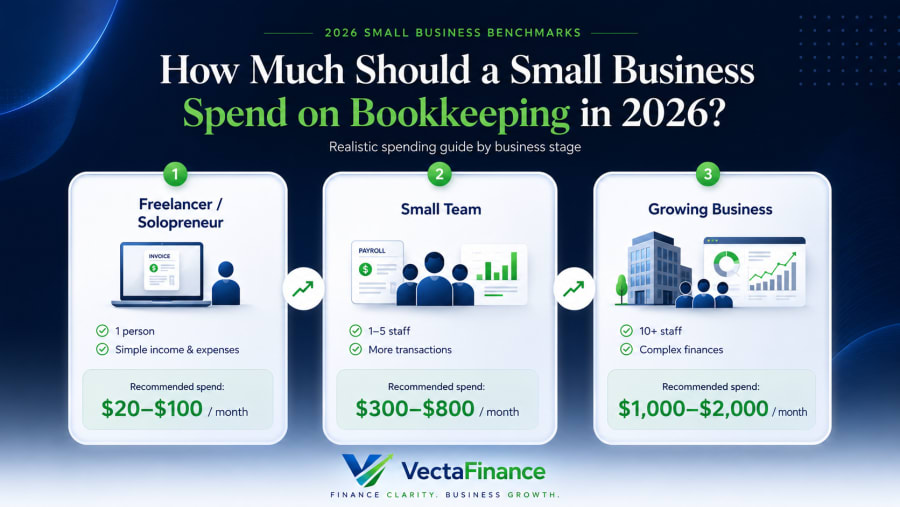
- Stage 1: Freelancer or solopreneur — just you, simple income and expenses
- Stage 2: Small team of 1–5 staff — more transactions, possibly payroll
- Stage 3: Growing business of 10+ staff — complex finances, multiple accounts
How Much Should You Spend — By Business Stage
Stage 1: Freelancer or Solopreneur
If you are working alone with straightforward income and expenses, you do not need a full-time bookkeeper. Your bookkeeping needs are simple — tracking income, categorizing expenses, and preparing basic reports for tax time.
Recommended spend: $20 – $100 per month
At this stage, AI bookkeeping software is the smartest choice. It costs a fraction of hiring a human, runs automatically in the background, and handles everything a solopreneur needs. You should not be paying $500 a month for bookkeeping when your finances are straightforward.
Stage 2: Small Team of 1–5 Staff
Once you have employees, bookkeeping gets more complex. You now have payroll, more transactions, and potentially multiple expense categories to track. A freelance bookkeeper or a mid-tier bookkeeping software starts to make sense here.
Recommended spend: $300 – $800 per month
A freelance bookkeeper at this stage typically charges $25–$50 per hour and will spend around 6–10 hours per month on your books. Alternatively, a solid bookkeeping software subscription with payroll features will cost $50–$150 per month — significantly cheaper with similar results.
Stage 3: Growing Business of 10+ Staff
At this stage your finances are genuinely complex. You likely have accounts payable, accounts receivable, payroll for multiple employees, and possibly multi-state compliance requirements. This is where investing in professional bookkeeping pays off.
Recommended spend: $1,000 – $2,000 per month
A professional bookkeeping firm or a part-time in-house bookkeeper makes sense here. The cost is higher but the accuracy, compliance protection, and time savings are worth it at this scale.
What Affects Your Bookkeeping Cost
The numbers above are starting points. Several factors push costs higher or lower:
- Transaction volume: More transactions per month means more hours and higher cost
- Payroll complexity: Managing employee salaries, benefits, and tax filings adds cost
- Industry: Businesses with inventory, multiple locations, or international clients cost more to manage
- Catch-up bookkeeping: If your books are behind, expect a one-time cleanup fee of $500–$2,000 before regular monthly costs begin
The Simple Rule of Thumb
Most financial advisors recommend spending 1–2% of your monthly revenue on bookkeeping. So if your business brings in $10,000 per month, a bookkeeping budget of $100–$200 is reasonable. At $50,000 per month revenue, $500–$1,000 makes sense.
If you are spending significantly more than 2% of revenue on bookkeeping alone, it is worth reviewing whether you are getting value for that cost — or whether a more efficient solution exists.
Should You Use AI Bookkeeping Software Instead?
For most small businesses — especially at Stage 1 and Stage 2 — AI bookkeeping software is genuinely the smarter financial choice in 2026. Modern AI bookkeeping tools can:
- Automatically categorize transactions
- Reconcile bank accounts in minutes
- Generate profit and loss reports instantly
- Save business owners an average of 4 hours per week
The cost? As low as $20–$50 per month — compared to $300–$800 for a freelance bookkeeper doing the same tasks.
If you want a full comparison of what AI bookkeeping costs versus a human bookkeeper, we have broken it down in detail here: AI Bookkeeper vs Human: Which Costs Less in 2026?
And if you are not sure whether AI bookkeeping is accurate enough for your business, this explains exactly how it works: What is AI Bookkeeping and How Does It Actually Work?
Signs You Are Underspending on Bookkeeping
Underspending on bookkeeping is just as dangerous as overspending. Watch for these warning signs:
- You do not know your profit margin off the top of your head
- Tax season causes panic every year
- You are mixing personal and business expenses
- Your invoices are not being tracked properly
- You have not reconciled your bank account in months
If any of these sound familiar, read this: 5 Signs Your Small Business Has Outgrown Manual Bookkeeping
The Bottom Line
How much should a small business spend on bookkeeping in 2026? Here is the simple answer:
- Freelancer / solopreneur: $20–$100/month (use AI software)
- Small team 1–5 staff: $300–$800/month (freelancer or mid-tier software)
- Growing business 10+ staff: $1,000–$2,000/month (bookkeeping firm)
The choice ultimately comes down to your business stage and complexity. But one thing is clear — in 2026, AI bookkeeping software gives small businesses a genuinely reliable, affordable alternative to traditional human bookkeeping. It saves time, reduces errors, and costs a fraction of the price.
The question is not whether you can afford good bookkeeping. It is whether you can afford not to have it.
Frequently Asked Questions
A freelance bookkeeper typically charges $25–$75 per hour in 2026 depending on experience and location. Newer bookkeepers charge $20–$30 per hour while certified professionals with years of experience charge $50–$100 per hour.
For very small businesses and freelancers, AI bookkeeping software is often a better value than hiring a human bookkeeper. It costs significantly less and handles most standard bookkeeping tasks automatically. A human bookkeeper becomes more valuable as your business grows and your finances get more complex.
Most small businesses pay between $300 and $2,000 per month for bookkeeping services in 2026. The exact amount depends on transaction volume, number of employees, and the complexity of your finances.
For most small businesses at an early stage, yes — AI bookkeeping software can handle the majority of day-to-day bookkeeping tasks reliably and at a much lower cost. As your business grows and financial complexity increases, a combination of AI software and human oversight becomes the most efficient approach.
Ready to try VectaFinance yourself?
Upload any bank CSV, Stripe, QuickBooks, or Xero export and receive a professional financial report with clear insights — usually within 24 hours.
Create Free Account & Test NowNo credit card required • 2 free reports every month • Cancel anytime